
Founder's note · Build Better
Why founder resilience is really about expectations
Telling founders to be more resilient does almost nothing. Resilience is mostly about expectations, the gap between what founders think funders want and what funders actually want, and the people around you. From our Resilient Founders work with LSE.
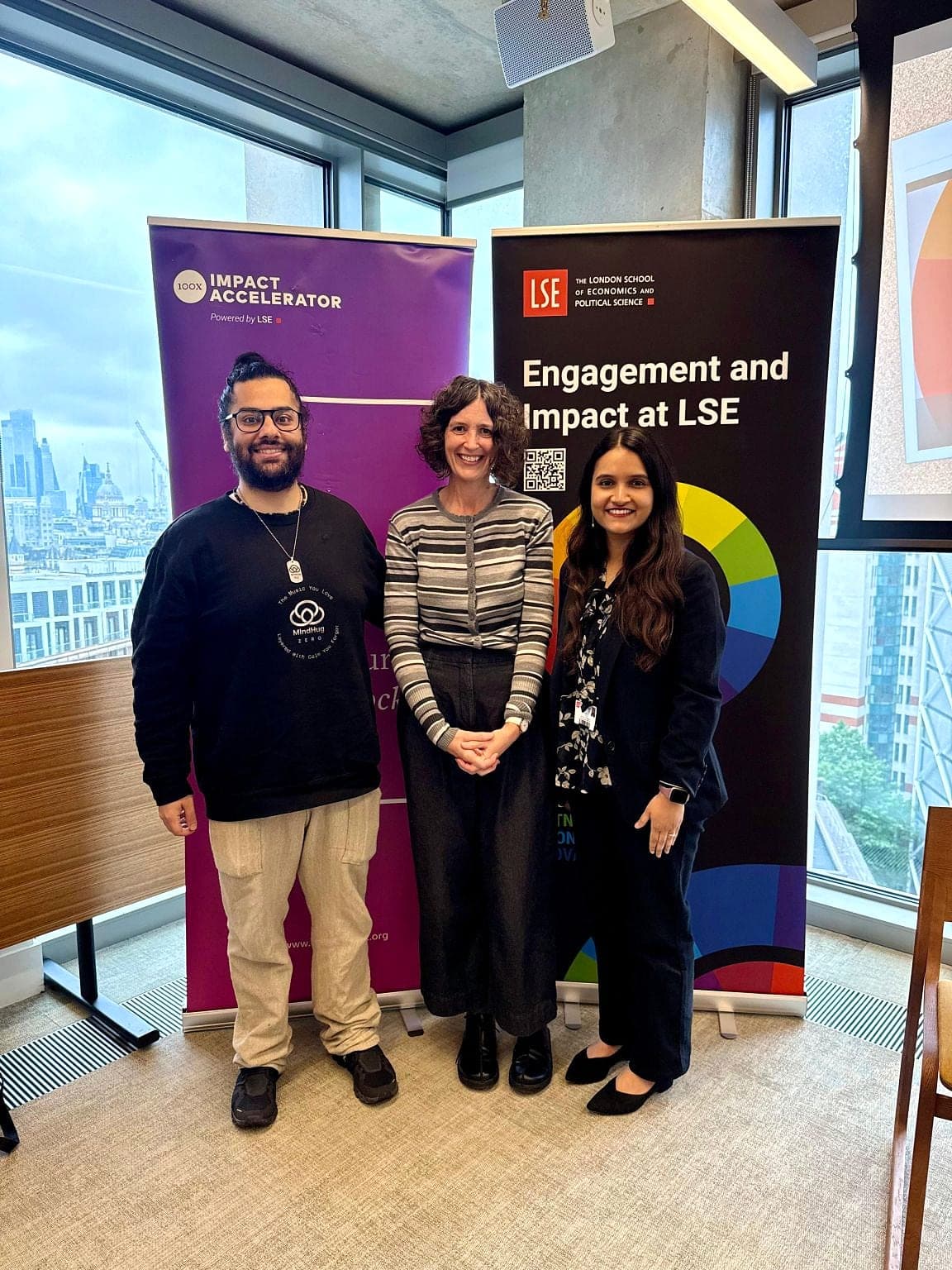
There is no way I should be the one talking about the behavioural science of founder resilience. I struggle like a lot of founders do. Or maybe that is exactly why I should.
Ahead of World Mental Health Day, Dr Paroma Bhattacharya and I sat down with Professor Elizabeth Stokoe at the London School of Economics (LSE) to talk about Resilient Founders: our cross-country research and programme, delivered by MindHug, LSE Generate and ATLAS SkillTech University, with support from the British Council and LSE.
The short version: telling founders to "be more resilient" does almost nothing. Resilience is not grit. It is mostly about expectations, and who you have around you.
Here is the full conversation from the LSE Impact Wednesday Meetup.
More information is not the problem
Founders are not short of advice. There is more to read, watch and process than ever, and no more hours to do it in. More information on its own does not change what we do.
What changes behaviour is what we expect. What we think investors want. What we think customers want. What we think a "real founder" looks like. Those expectations decide whether we make the ask, take the risk, or quietly hold back. Knowing the move and still not making it is where a lot of founders get stuck.
The gap between founders and funders
A big part of the work is the relationship between founders and funders. Not the term sheet. The expectations on both sides, and the gap between them.
- What founders think funders want. Often relentless confidence, so they hide the doubts and ask for less help than they need.
- What funders actually want. Often honesty about the risks, and they read the hiding as a worse sign than the doubt would have been.
- The gap shapes how confidently founders raise, the risks they take, and whether they go for growth. It moves the returns funders are after too.
Close the gap and both sides do better. That is not a wellbeing nicety. It is startup infrastructure.
Building alone makes it worse
Building a company is lonely. You carry more uncertainty than anyone you employ, and most of it you carry quietly.
You cannot check your expectations on your own. Left alone, the mind fills the gaps with the worst version: everyone else has it sorted, asking for help looks weak, the doubt means you are not cut out for this. None of that is usually true.
People who have been through the same thing can see your expectations from the outside, challenge them, and offer help that actually fits. That is what community does, and it is why we build it into the work rather than bolt it on.
Where this sits in MindHug
This is why founder wellbeing and psychological safety sit inside Build Better, one of our three pillars: Feel Better, Adapt Better, Build Better. Not a soft add-on, but the ground entrepreneurial behaviour is built on.
If you do not feel safe enough to be honest, with a funder, a cofounder, or yourself, you play it safe exactly when you should not.
We also brought MindHug Zero into the work with the founders: the music you already love, to help you find calm and focus, with zero change to your habits. Their response floored us.
The one line to take away
Founder wellbeing is not a side issue, a luxury or a perk. It is a core part of a healthy startup ecosystem, and academia and industry have to build it together.
Thank you to Paroma, Professor Elizabeth Stokoe, LSE, the British Council and the 100x Impact Accelerator for the conversation and the support.
One question we left the room with, and one worth sitting with: what is one expectation about entrepreneurship that experience changed for you?
The evidence
Resilient Founders is cross-country action research and a programme delivered by MindHug, LSE Generate and ATLAS SkillTech University, with support from the British Council and LSE. It looks at founder wellbeing, psychological safety and the founder-funder relationship. We measure the behavioural change and share what is relevant to your setting in the conversation. The conversation above was recorded at the LSE Impact Wednesday Meetup on 7 October 2026.
- Resilient Founders, LSE Impact Wednesday Meetup, 7 October 2026: youtu.be/7rVIq_xNXvQ
This article is general wellbeing information, not medical advice. MindHug is a behavioural-science organisation, not a medical or clinical provider, and does not diagnose or treat health conditions. If you are struggling with your mental health, or with anxiety, low mood or distressing thoughts, please speak to a GP or a qualified mental-health professional. In a crisis in the UK you can call 999, or contact Samaritans free, any time, on 116 123.
The Signal
One behavioural idea worth keeping, now and then. No noise, just signal. Leave your email and we will send the good stuff.
Where this leads
The programme behind this is Entrepreneur Resilience and Mindset. For anything specific to your setting, the fastest route is a conversation.
Filed under Build Better, Feel Better. By Chitraj Singh, Founder of MindHug. Last updated 2026-10-17.