
Training · Feel Better
Psychological safety training: what it is, and why ours feels different
Psychological safety is the felt ability to close the gap between how fully you want to take part and how able you feel to. Here is what it is, what gets in the way, and why our training changes what people do, not just what they can define.
What is psychological safety? The workplace definition, and a wider one
Start with the definition most people know, from Amy Edmondson's research on how teams learn: psychological safety is the shared belief that you can take an interpersonal risk without being punished, humiliated or made to feel small for it. That is right, and it is the foundation. We would add one thing. It is not only about work.
The same thing is at play far beyond any one team: a student who does not put their hand up, someone too unsure to try a new tool at work, a person who will not report a mistake, a founder sitting on an idea, anyone who does not ask for help when they need it.
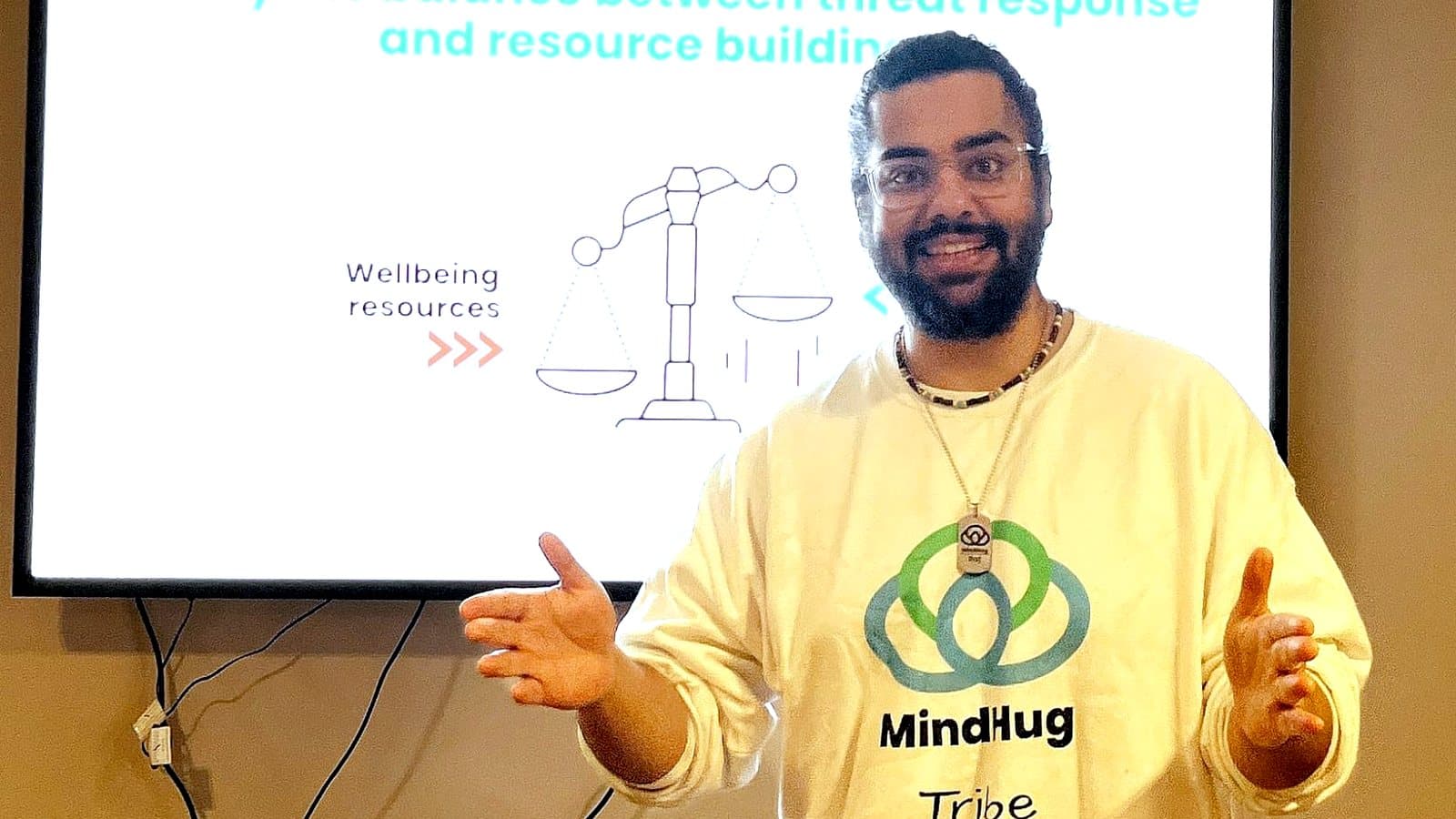
It shows up anywhere you want to take part and are not sure it is safe to, which is to say, in every setting we work in, and everyone in them.
In practice it lives in small, risky moments: speaking up, asking a question, disagreeing, admitting a mistake, saying "I don't know", asking for help, or challenging something that feels wrong. Where it is present, people do these things. Where it is missing, they go quiet.
Those are the behaviours you can see. The same mechanism runs deeper, and the same read works whether the room is a boardroom, a lecture hall or a kitchen table.
The gap underneath it
The same shape sits under all of it, at work and well beyond it. There is how fully you want to take part in a situation, and the people in it, and how able you feel to right now.
The space between the two is a behavioural gap: you cannot act the way you want to, or you act in ways you would rather not. Psychological safety, at its root, is the felt ability to close it, which is why we treat it as a behavioural problem, not a slogan.
What opens the gap depends on the situation. In a workplace it is often the fear of speaking up or being blamed. In a new career, a hard conversation, a diagnosis, a move, or learning something difficult, it can be something else entirely.
The constant is not the cause. It is the felt inability to close the distance between where you want to be and where you feel you can be.
The bigger and more threatening the gap feels, the more the mind reaches for protection: silence, avoidance, defensiveness, resistance to change, hiding a mistake, overthinking, or quietly reverting to what you already know.
These are not character flaws. They usually make sense given what the mind believes is happening. The goal is not to tell people to behave better. It is to understand what the behaviour is protecting them from, and change the conditions underneath it.
CUE: what widens the gap
Three things tend to stretch the gap. We call them CUE, because they are the cue that something is getting in the way.
- Capability. "I don't know if I can handle this." Sometimes that is real: a missing skill, resource or support. Sometimes it is perceived: confidence, old experiences, or how threatening the situation feels.
- Uncertainty. "I don't know what happens if I do this." Will I look stupid? Will I be blamed? What am I meant to do next? Uncertainty can be genuinely in the room, or amplified by a mind filling the gaps with the worst case.
- Expectations. "This isn't how it was supposed to go." When reality drifts too far from what we expected, of ourselves, a manager, a change or a technology, the mind becomes more protective, which makes the wanted action harder still. A loop forms.
It is not just in your head
This matters, because psychological safety is not simply a mindset to fix. Sometimes the environment genuinely is unsafe: punitive management, bullying, exclusion, unclear expectations, unrealistic workloads, real job insecurity, or technology nobody was trained to use.
Other gaps are more perceptual: assumptions, fear carried from a past experience, overestimating the threat, underestimating your own capability. Usually the two interact.
So we work on both the person and the environment around them, rather than telling an individual to be more confident. Telling someone to speak up in a room that punishes candour is not safety. It is a setup.
How SURE closes the gap
If CUE names the gap, SURE is how we work on it. It is the mechanism behind everything in the Psychology of Change.
- Safety. Enough psychological and nervous-system safety, and capacity, to explore something different.
- Understanding. What is actually happening, inside the person and around them.
- Reframing. Testing the assumptions, and finding other ways to read and respond to the situation.
- Experience. Practising the new behaviour for real, so experience updates expectation. This is the part that sticks.
It is deliberately not four boxes on a slide. The point is the last step: people rehearse the behaviour, so the brain gets new evidence, not just a better argument. The same read works in very different rooms, here it is in five of them.
Try it
Different situations, the same mechanism. Tap one and watch the gap, the behaviour it produces, and the move that reopens the action.
You want to
Say the thing everyone is thinking
Feel Better
The gap · Uncertainty
No read on how it will land, or what it costs you if it lands badly.
So instead
You stay quiet, and the concern surfaces too late.
Same mind, different rooms. The behaviour is protective, not a flaw. Change the conditions underneath it and the action becomes available again. This is the read we use in our programmes.
Three things run through everything we do
Whatever the situation, the same three threads do the work.
- Psychological and nervous-system safety and capacity, to try something different. If someone feels under threat, more information rarely helps. First, enough capacity to engage.
- Practical skills and capability, to handle what is actually happening. Safety without capability is not enough; people also need to know what to do.
- Experiential, hands-on practice, that makes the change real. People rehearse the behaviour rather than simply agreeing with it.
Safety is not the same as comfort
Psychological safety is not about everyone feeling comfortable. Growth is often uncomfortable. The aim is not a world with no uncertainty. It is feeling capable enough to act when uncertainty is there.
Done well, safety does not remove the risk. It makes the risk survivable enough to take.
What our training actually feels like
Most training defines the term and treats it as a workplace metric. Ours is different in two ways. First, we treat psychological safety as a mechanism that runs through all of life, not only a team, which is why the same work reaches wellbeing, change and building something, and why it holds up outside the meeting room.
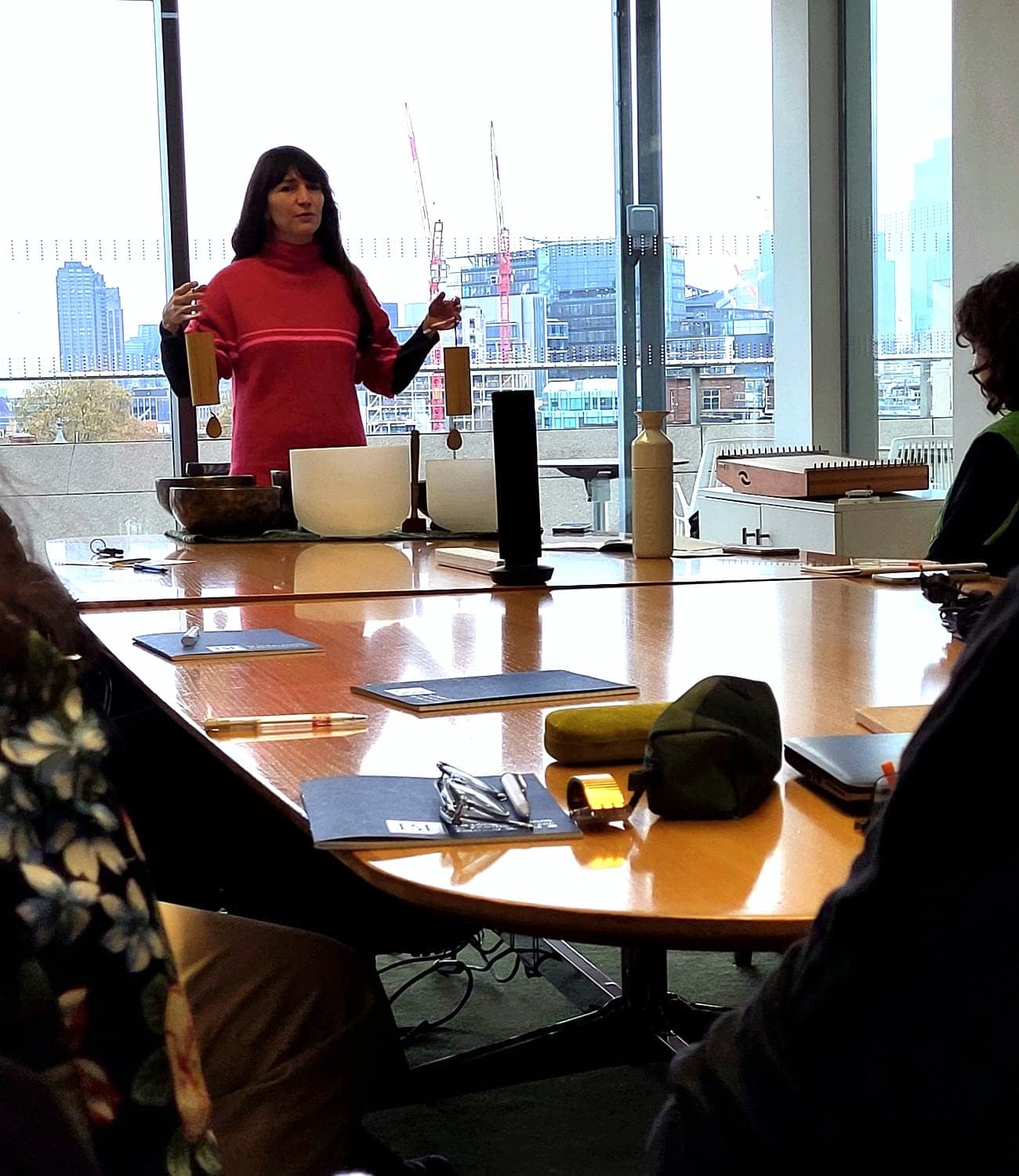
Second, it is experiential: people practise the moments that matter, giving hard feedback, disagreeing upward, owning an error, in a setting built to make that safe.
Different people need different routes into safety, understanding and new behaviour. So sessions draw on behavioural science and psychology alongside, where they fit, breathwork, sensory and sound-based exercises, art-based exercises, games, live demonstrations, role-play, real work and facilitated reflection.
We are precise with language here: these are exercises, not clinical music therapy or art therapy, unless a qualified practitioner is delivering them as such.
Some of this reaches beyond the room. Our work on nervous-system safety through sound is where MindHug Zero came from, wellbeing frequencies blended with your own music, for calm, focus and sleep. It is not part of the training, but it comes from the same idea: the state you are in changes what you are able to do.
Roughly, it is what happens if a psychologist, a mindfulness practitioner and a game designer ran a hackathon together, then measured whether anything actually changed.
Safety is not only a wellbeing issue
Psychological safety decides whether people feel better, adapt better and build better. The same mechanism shows up across all three, and we measure it.
- Feel Better, in wellbeing and resilience, the safety to ask for help before burnout, not after. Across the cohorts we measured it, 8 in 10 improved their wellbeing.
- Adapt Better, in AI and digital security, reporting a mistake early, trying an unfamiliar tool, admitting what you do not yet understand. On our DSIT digital-skills work, 96% of psychological-safety measures increased.
- Build Better, in innovation and entrepreneurship, proposing the idea, testing it, recovering when it fails. On our founder programme, 100% of founders improved in psychological safety.
We measure these shifts with recognised instruments, before and after, at participant level, and share the figures relevant to your setting directly. You can see how the pieces fit in our programmes and case studies.
Common questions
What is psychological safety? The shared belief that you can speak up, disagree, ask a question or admit a mistake without being punished or humiliated for it.
Can psychological safety be trained? Yes, but not by defining it. It shifts when people experience the risky moments going differently, and when the conditions around them change too.
Is it the same as trust? Close, but not the same. Trust is about a specific person over time. Psychological safety is about the group: can I take a risk here, now, without it being held against me.
Does it mean everyone feels comfortable? No. It means people feel safe and capable enough to be uncomfortable, to disagree, stretch and take sensible risks.
What causes low psychological safety? A mix: past experience of candour being punished, unclear expectations, status, blame cultures, and gaps in skill or support. Usually the environment and a person's read of it at once.
How do you measure it? With recognised pre and post instruments at participant level, alongside behaviour and the outcomes that matter to the team.
What has it got to do with AI or cybersecurity? A great deal. Whether someone reports a cyber mistake or admits they do not understand an AI tool is a psychological-safety question before it is a technical one.
If you remember one thing
Psychological safety is what makes action available. When the gap between what someone wants to do and what they feel safe and capable enough to do grows too large, behaviour turns protective. CUE helps us understand the gap. SURE helps us close it, with safety, capability and experience, so people can practise the behaviour they actually need.
Feel better. Adapt better. Build better. Different situations, the same human mind.
The evidence
We measure shifts in psychological safety and wellbeing with recognised instruments, before and after, at participant level. The relevant evidence for your setting is shared in the conversation, not invented for a web page.
- Amy C. Edmondson, The Fearless Organization (Wiley, 2019).
- Edmondson, A. C. (1999). Psychological Safety and Learning Behavior in Work Teams. Administrative Science Quarterly, 44(2), 350–383.
Bring psychological safety training to your team
Experiential training that changes what people do, shaped around your group.
The Signal
One behavioural idea worth keeping, now and then. No noise, just signal. Leave your email and we will send the good stuff.
Filed under Feel Better, Adapt Better, Build Better. By MindHug. Last updated 5 November 2026.