Guide · Feel Better
What is a sound bath? What it does, and how to book one
A sound bath is a session where you lie still while bowls, gongs and chimes fill the room. What it does, where it came from, and how to book one for your group.
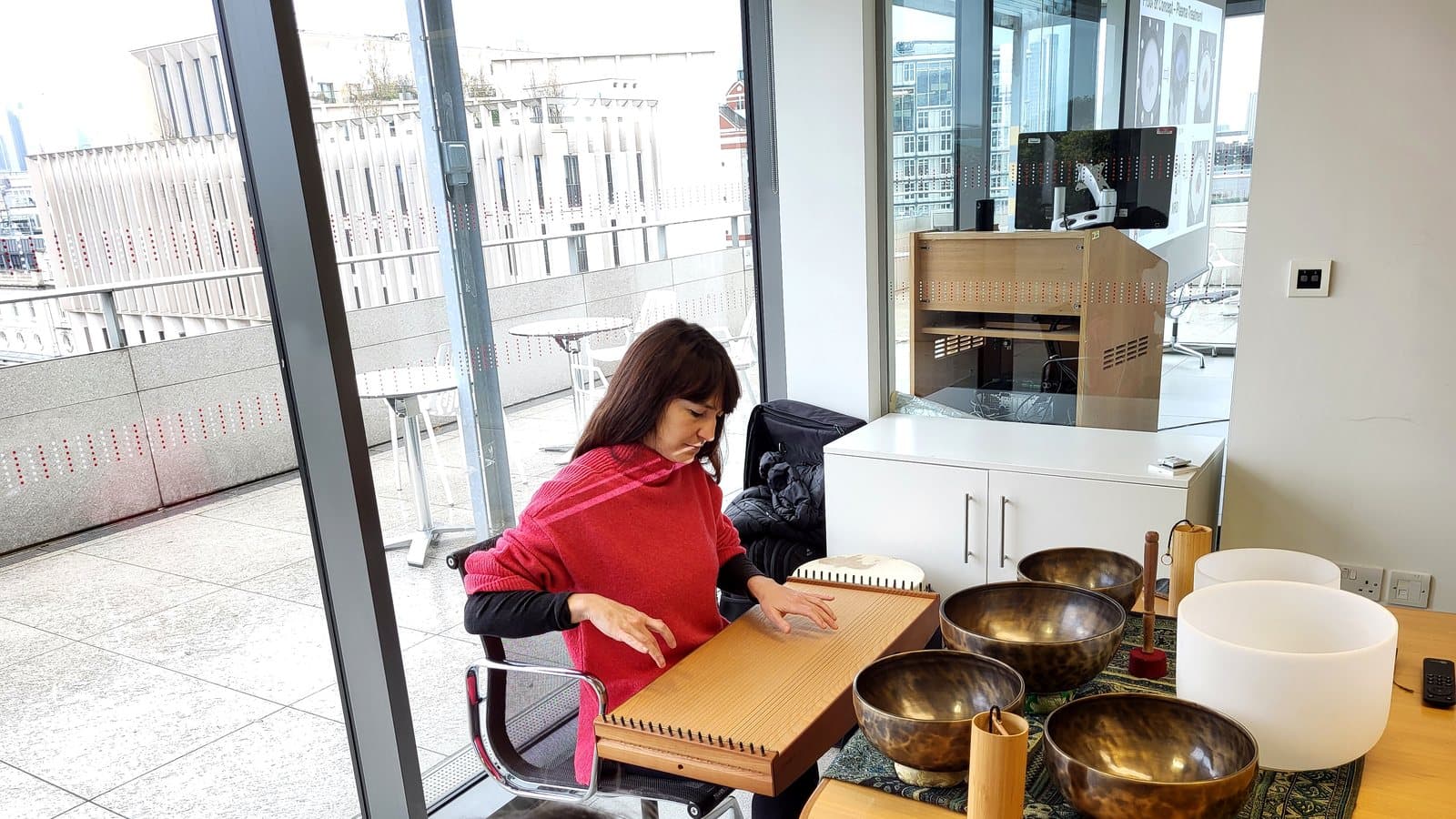
A sound bath is a session where you lie or sit still while a practitioner plays singing bowls, gongs, chimes or a monochord. Nobody teaches you anything and you have nothing to get right. The sound fills the room and you listen. That is the "bath".
Book a sound bath for your group
In person or online. Tell us the size of your group and roughly when.
Want to compare? See all our wellbeing experiences.
What happens in one
- Settle. You get comfortable and the practitioner slows the room down with the breath.
- Listen. The instruments build in long, overlapping layers, with no tune to follow.
- Come back. The sound fades, and you take a few minutes before getting up.
Most people say they feel calm, rested and a little heavy afterwards. Some fall asleep, which is fine too.
What it does
People come to switch off, and most say they do. They describe feeling calmer and lighter, and some say they sleep better that night.
In one study of 62 adults, people reported less tension, anger, fatigue and low mood after a singing bowl session. Those new to it felt the biggest drop in tension.
For a group, there is more to it. Phones go away, there are no decisions to make, and everyone stops at once. Slow, steady sound is one of the signals the nervous system can recognise as safe, and those signals help build the psychological conditions people need to feel better. That is why safety is the first step in SURE, our model for change, and the first step towards adapting and building.
The hypnagogic state
Many people describe drifting somewhere between awake and asleep during a sound bath. That in-between stage has a name: the hypnagogic state. Images or fragments of sound can appear while you are still partly aware.
Some people say they lose track of time here, and that it is the best part of the session.
The frequencies
A singing bowl does not play one note. It rings with many frequencies at once, most of them below 1,000 Hz. Pairs of almost-matching frequencies pulse against each other, and that is the slow wobble you hear. Some people say they feel it in the body as much as they hear it.
Some people also seek out particular frequencies, such as binaural beats or solfeggio tones, for sleep, focus or calm. We explain how these fit together in music therapy, therapeutic music and sound therapy: the difference.
Where it came from
Bells, gongs, drums and chanting have brought people together across many cultures for centuries.
Singing bowls reached a wide Western audience from the 1970s, with an album called Tibetan Bells, released in 1972 by the American musicians Nancy Hennings and Henry Wolff. Interest grew quickly from the 1990s, and sound baths now run in studios, workplaces and online.
Book one for your group
We run sound baths for groups, in person or online, as a session on its own or as part of our training. If anyone is sensitive to sound, just let us know.
Book a sound bath for your group
In person or online. Tell us the size of your group and roughly when.
Want to compare? See all our wellbeing experiences.
Sources
- Goldsby, Goldsby, McWalters & Mills (2017), Effects of singing bowl sound meditation on mood, tension, and well-being: an observational study. Journal of Evidence-Based Complementary & Alternative Medicine. pubmed.ncbi.nlm.nih.gov/27694559/
- Ghibellini & Meier, The hypnagogic state: a brief update. Journal of Sleep Research. boris.unibe.ch/172390
- Acoustics of singing bowls: modal pairs, beating and frequency range. DAGA 2014, University of Oldenburg. pub.dega-akustik.de/DAGA_2014/data/articles/000254.pdf
- Grimes (2020), Tibetan singing bowls. Tricycle. tricycle.org/article/tibetan-singing-bowls/
This article is general wellbeing information, not medical advice. MindHug is a behavioural-science organisation, not a medical or clinical provider, and does not diagnose or treat health conditions. If you are struggling with your mental health, or with anxiety, low mood or distressing thoughts, please speak to a GP or a qualified mental-health professional. In a crisis in the UK you can call 999, or contact Samaritans free, any time, on 116 123.
The Signal
One behavioural idea worth keeping, now and then. No noise, just signal. Leave your email and we will send the good stuff.
Where this leads
For anything specific to your people and your setting, the fastest route is a conversation.
No obligation.
A few lines is enough.
Filed under Feel Better. By MindHug. Last updated 2026-11-05.